
When the Support at Home paperwork arrives, most people look for one line: the classification. It's a number from 1 to 8, and it decides your government funding each quarter. What the letter doesn't spell out is how much of that is really yours to spend on services, or how quickly it needs to be used.
This post turns the number into something you can plan a week around. It's a practical companion to our longer guide, Support at Home funding levels 2026: classifications 1 to 8 explained.
General information only. Amounts are those in force from 1 October 2026. They're indexed, so confirm current figures with My Aged Care before you make plans.
Where your classification comes from
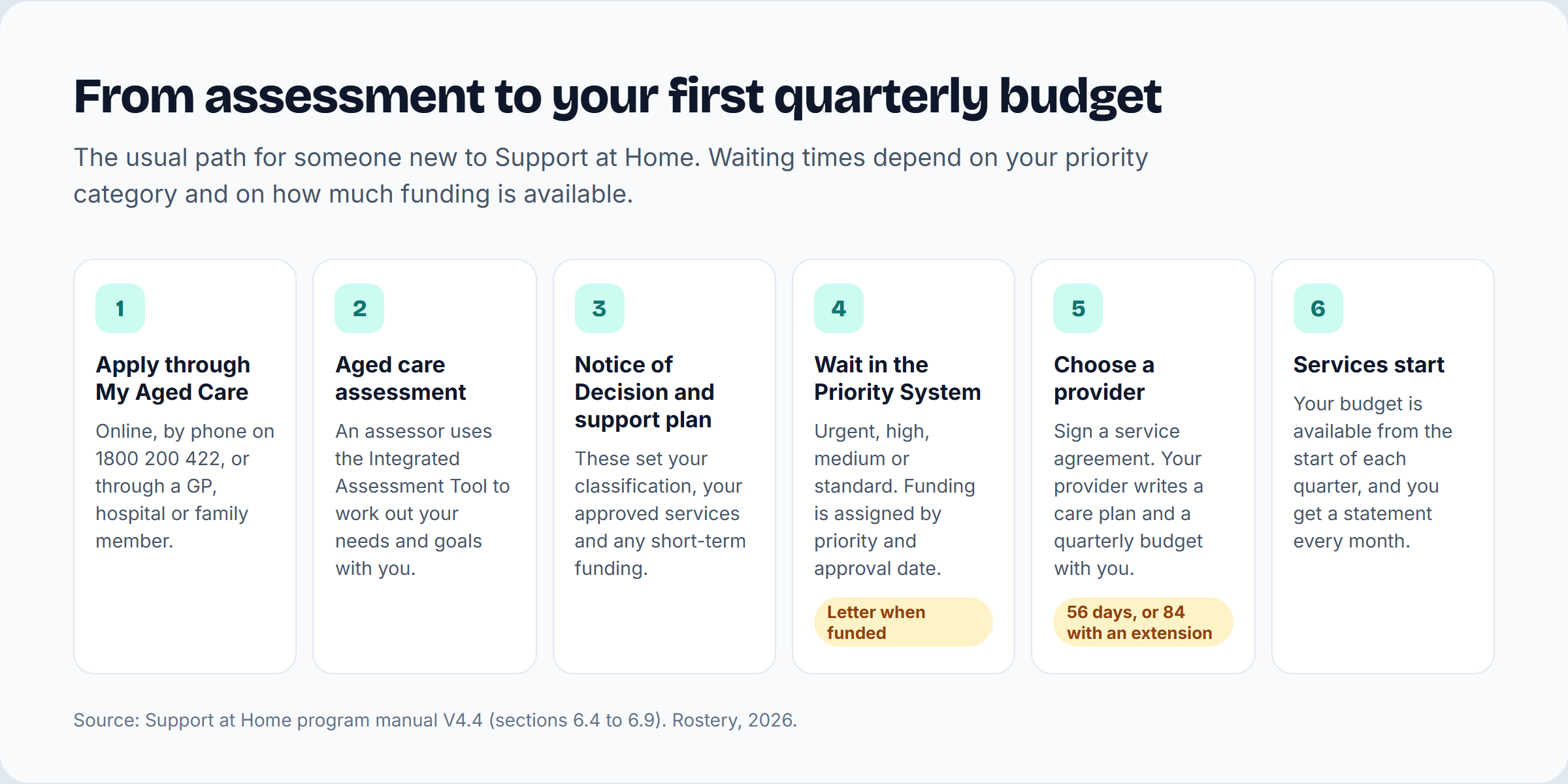
Your classification comes out of an aged care assessment. The assessor works through the Integrated Assessment Tool with you, and a separate Assessment Delegate makes the formal decision. You receive a Notice of Decision and a support plan, which together set out your classification, any short-term funding and the services you're approved for.
You can't pick your classification, and your provider can't change it. If you're new to the term, our glossary has a short entry on what a Support at Home classification is.
The official amounts, and what's left for services
Here are the quarterly budgets published by the Department of Health, Disability and Ageing from 1 October 2026. The last column is our own rounding: the annual amount, less the 10% set aside for care management, divided by 52.
| Classification | Quarterly budget | About per week for services |
|---|---|---|
| 1 | $2,757.89 | $191 |
| 2 | $4,120.89 | $285 |
| 3 | $5,645.23 | $391 |
| 4 | $7,632.04 | $528 |
| 5 | $10,202.32 | $706 |
| 6 | $12,365.48 | $856 |
| 7 | $14,944.20 | $1,035 |
| 8 | $20,073.50 | $1,390 |
So "Classification 4" means roughly $528 a week to spend on services, not the $587 you'd get by dividing the full annual amount by 52.
Four things that move the number
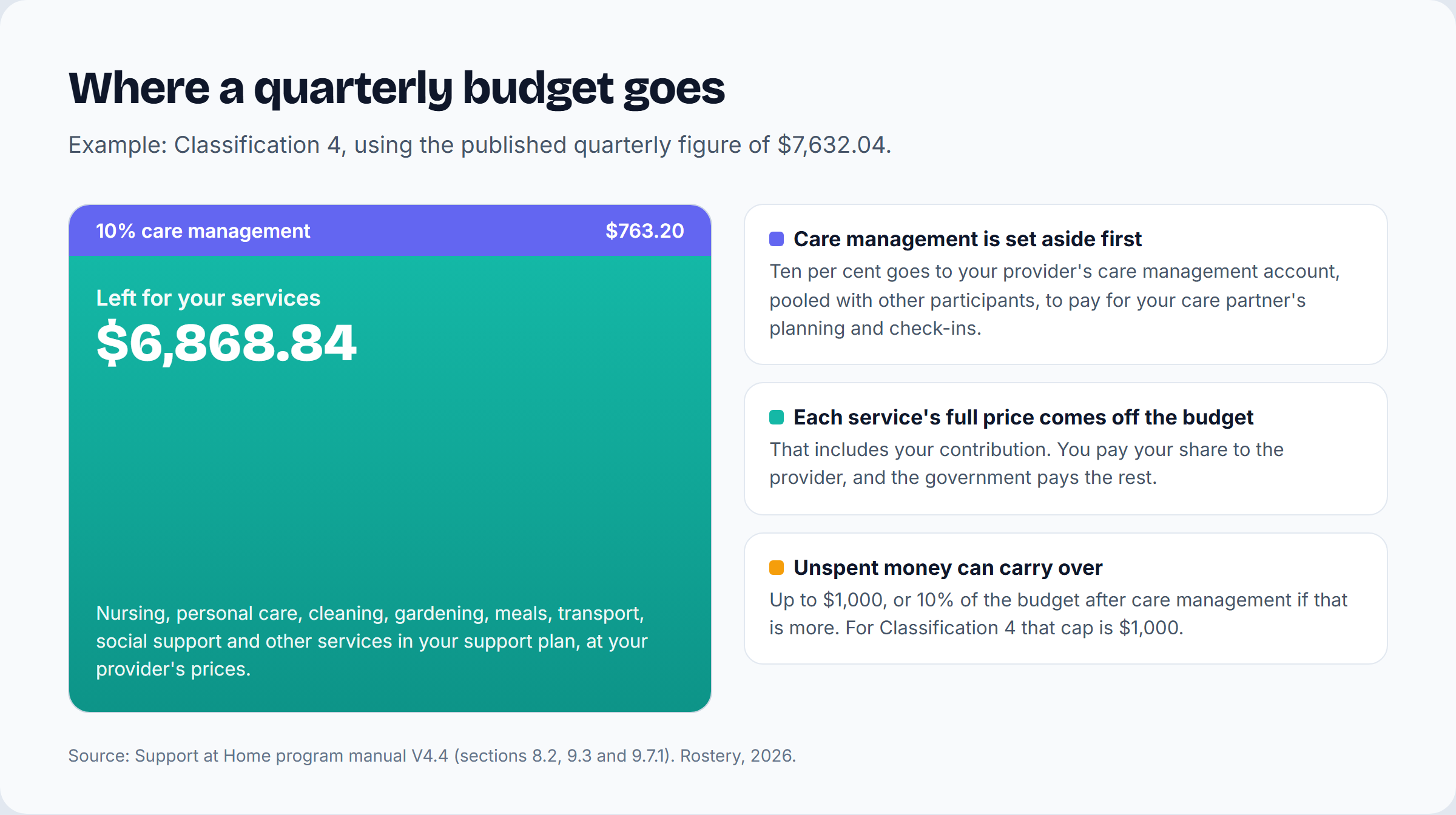
1. Care management comes off the top. Ten per cent of each quarterly budget goes to your provider's care management account, pooled with other participants. It pays for your care partner's planning, reviews and check-ins, and you make no contribution towards it. Under the program manual, your provider should spend at least 15 minutes of direct care management time with you every month. Our free care management calculator shows the set-aside for every classification.
2. You might start on 60%. When demand is higher than expected, people can be given interim funding of 60% of their classification first, with the remaining 40% allocated when it becomes available. People in the urgent priority category always get full funding.
3. The quarter's length matters. The published quarterly figure is the annual amount divided by four. The program manual works the real budget out by days, so Classification 4 comes to $7,694.77 for October to December 2026, which has 92 days. Starting mid-quarter? Then the first budget only covers the days between your start date and the end of that quarter.
4. Your contribution doesn't stretch the budget. When a service is claimed, its full price comes off your budget. Your contribution is the part of that price you pay the provider, and the government pays the rest. Personal care has needed no contribution since 1 October 2026.
The clock, and what carries over
The day funding is allocated, a 56-day clock starts. By the end of it you need a provider, a signed service agreement and services under way. Running short of time? A call to My Aged Care can add 28 days, for 84 in all.
After that, unspent money carries into the next quarter only up to a limit: $1,000 or 10% of the budget after care management, whichever is higher. For classifications 1 to 5 that's $1,000. For Classification 8 it's $1,806.62. The rest is lost, so plan a quarter's services rather than saving up.
If the money isn't enough
Ask for a Support Plan Review. You can do it through My Aged Care, or your provider can request one with your consent. That can result in a fresh assessment and a move up. A move mid-quarter changes your budget from the day the higher classification applies, not from the start of the quarter.
Moved across from a Home Care Package?
You'll hold a transitioned HCP level instead of a number from 1 to 8, with funding matched to your old package. For example, a transitioned Level 3 is $10,808.30 a quarter. Our Home Care Package to Support at Home calculator shows what each package level became and which contribution rules carry over.
A quicker way to compare
If you'd rather click than read tables, our free Support at Home Classifications Explained tool puts all eight classifications and the four transitioned HCP levels side by side. You can view each one by year, by quarter or by day, and pick a classification to see its care management share, what's left for services each quarter and its carry-over limit. It also lists the short-term pathways, such as the Restorative Care Pathway at $6,179.40 for an episode of up to 16 weeks. It's free, with no sign-up.
For providers reading this
Once interim funding, part-quarter starts and carry-over are applied, no two participants' quarters look alike. Rostery's Support at Home classifications and budgets feature generates each quarterly budget from the participant's classification, records carry-over up to the cap and no further, and shows committed and remaining funds while the quarter is still running.
If you're helping a parent through all of this for the first time, our Medium post Helping a parent get care at home in 2026 covers the steps before the letter arrives.
Sources: My Aged Care, Support at Home costs and contributions (amounts current as of 1 October 2026); Department of Health, Disability and Ageing, Support at Home program manual v4.4 (September 2026), sections 6.8, 6.9, 7.6, 9.2 and 9.7. Read 30 to 31 October 2026.
Written by the Rostery team in Sydney. Rostery makes software for NDIS and aged care providers.
Comments
Post a Comment