
If you or a parent gets help at home through Support at Home, you may have noticed that two providers can charge quite different prices for the same hour of cleaning. That's allowed. In May 2026 the government put price caps on hold, so each provider sets its own prices. What they can't do is charge a price they can't explain.
Here's a simple check you can do at the kitchen table. It's a shorter, family-focused take on our longer guide to Support at Home prices in 2026, updated with the national figures the department released in October.
General information only. Prices and rules can change, so check My Aged Care or ask your provider about your own situation.
Step 1: Find your provider's price list
Every provider has to publish the price it charges most often for each service, both on its own website and on the My Aged Care "Find a provider" tool. The website list should cover weekdays, after hours, weekends and public holidays.
Your service agreement must also list the price for each service you'll get. If a price in your agreement is higher than the published one, the agreement has to say why.
Step 2: Compare it with the national figures
The Department of Health, Disability and Ageing now publishes a national summary of what providers charge. The latest, released in October 2026, covers January to March 2026. Here are some of the median weekday prices for a 1-hour service, with the range that the middle half of providers charged:
- house cleaning: $110 ($100 to $117)
- personal care, such as help showering and dressing: $113 ($105 to $120)
- individual social support: $110 ($100 to $120)
- gardening: $115 ($97 to $140)
- registered nurse: $180 ($160 to $198)
- physiotherapist: $195 ($143 to $226)
These are weekday prices only, and weekends often cost more. They combine city, regional and rural services. And they're not caps or recommended prices. The department says a price above the range isn't necessarily unreasonable, and a price inside the range isn't automatically reasonable. A price well above the range is a reason to ask why, not proof of a problem.
If you're not sure what a service on your statement actually covers, our free Support at Home service list explains each of the 49 services, what's excluded and who pays a contribution.
Step 3: Work out what you actually pay
The full price comes out of your quarterly budget. You pay a share of some services, depending on the type of service and your income and assets assessment.
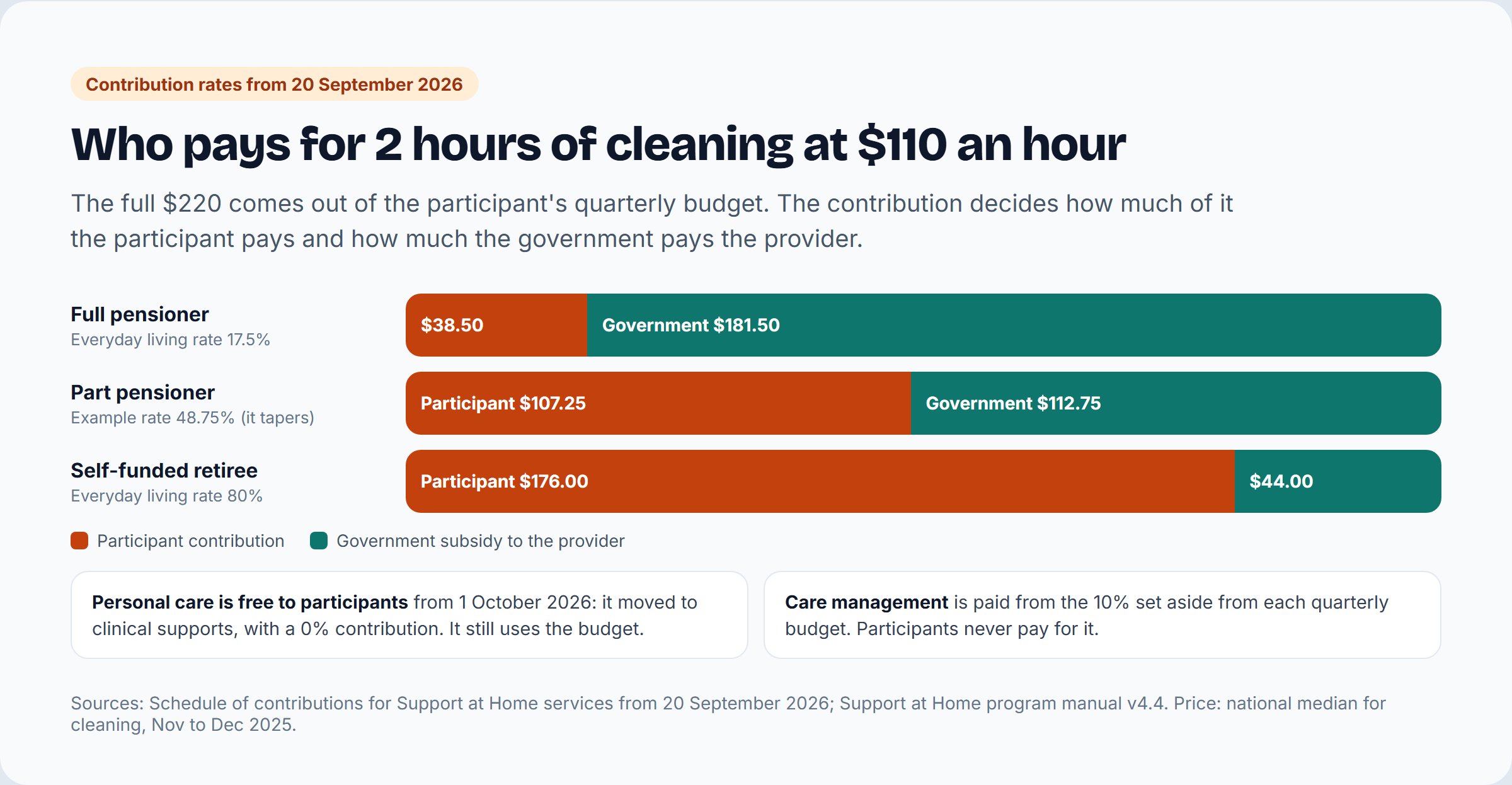
- Clinical care such as nursing, physio and care management: you pay nothing. Since 1 October 2026, personal care is in this group too.
- Independence services such as social support, respite and transport: full pensioners pay 5%, and others pay more, up to 50%.
- Everyday living such as cleaning, gardening and meals: full pensioners pay 17.5%, up to 80% for self-funded retirees without a Commonwealth Seniors Health Card.
So for 2 hours of cleaning at $110 an hour, a full pensioner pays $38.50 and the remaining $181.50 comes from the budget. Our Support at Home budget and contribution calculator can do this for a whole week of services. If you're still working out what your classification is worth each quarter, we've also written about Support at Home funding levels from 1 October 2026.
Step 4: Check for charges that shouldn't be there
A provider's price has to include everything: wages, travel to your home, administration and a reasonable margin. So you shouldn't see:
- a separate travel fee or administration fee
- a separate package management fee
- a charge for care management (it comes from the 10% of your budget set aside for it)
- an entry fee for starting, or an exit fee for leaving
- more time than you received, such as 45 minutes charged as an hour.
If a price is going up, check your agreement. Any regular increase clause must say when the increase happens, how it's worked out and why. The government has also asked providers to put prices up no more than two times in a year.
One charge that can be fair is a late cancellation. If you cancel with less than 2 business days' notice, the provider may be paid in full, unless there were reasonable grounds such as a hospital stay. The policy should be in your agreement.
Step 5: Ask, and know where to go next
Start by asking your provider to explain the price. Prices must be reasonable and clearly explained, and the Aged Care Quality and Safety Commission can require a provider to correct an unreasonable price and refund overcharges.
If you're not happy with the answer, you can:
- call the free Aged Care Advocacy Line on 1800 700 600, run by the Older Persons Advocacy Network
- make a complaint to the Aged Care Quality and Safety Commission on 1800 951 822
- change providers at any time, at no cost.
If you decide to switch, lock in a start date with the new provider first, and only then agree an end date with the old one. The department suggests this order so care doesn't stop in between. Our earlier post, Before you sign with a Support at Home provider, has questions to ask a new provider. For a quick definition of the program itself, see our glossary entry on what Support at Home is.
Sources: Department of Health, Disability and Ageing, National summary of Support at Home prices, January to March 2026 (October 2026); Consumer protections for Support at Home prices (May 2026); Prices for Support at Home participants; Support at Home program manual v4.4; My Aged Care, Support at Home costs and contributions. Read 30 October 2026.
Written by the Rostery team in Sydney. Rostery makes software for NDIS and aged care providers.
Comments
Post a Comment