
Originally based on our full guide, SIRS reporting criteria: Priority 1 and Priority 2 explained. This is a shorter version for people working in clients' homes. General information only, not legal advice.
If you work in home care, you're often the only person who sees what happens during a visit. That makes you the most important link in the Serious Incident Response Scheme, or SIRS, which covers in-home aged care, including Support at Home, as well as residential care.
You don't have to lodge anything with the regulator yourself. Your provider does that. But your provider can only meet its deadlines if you report quickly, and if the coordinator who takes your call knows which deadline applies. Here are five questions that sort most situations out.
Question 1: did I see, hear or suspect one of the eight things?
SIRS covers eight types of incident involving a person receiving funded aged care:
- unreasonable use of force
- unlawful sexual contact or inappropriate sexual conduct
- psychological or emotional abuse
- unexpected death
- stealing or financial coercion by a staff member
- neglect
- inappropriate use of a restrictive practice
- unexplained absence while care is being delivered
"Suspect" is part of the test. Something you were told, something that doesn't add up, or an injury nobody can explain all count. You report what you know. You don't need proof, and you don't need the client's permission.
Question 2: is it one of the three that are always urgent?
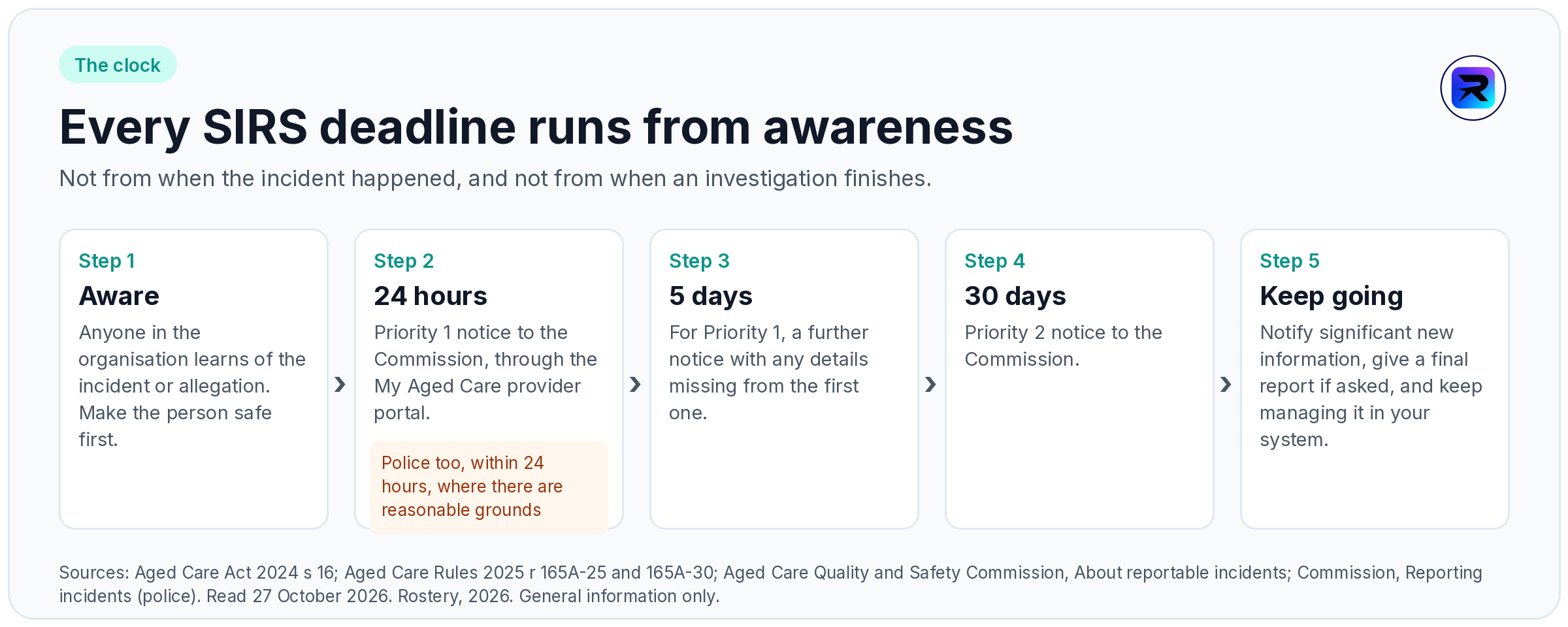
Under the Aged Care Rules 2025, three types are always Priority 1, so your provider has 24 hours to tell the Aged Care Quality and Safety Commission:
- unlawful sexual contact or inappropriate sexual conduct
- an unexpected death
- an unexplained absence, such as a client you can't find when you arrive or who goes missing during an outing
If it's one of these, ring your coordinator or on-call line straight away. Don't wait until the end of your shift.
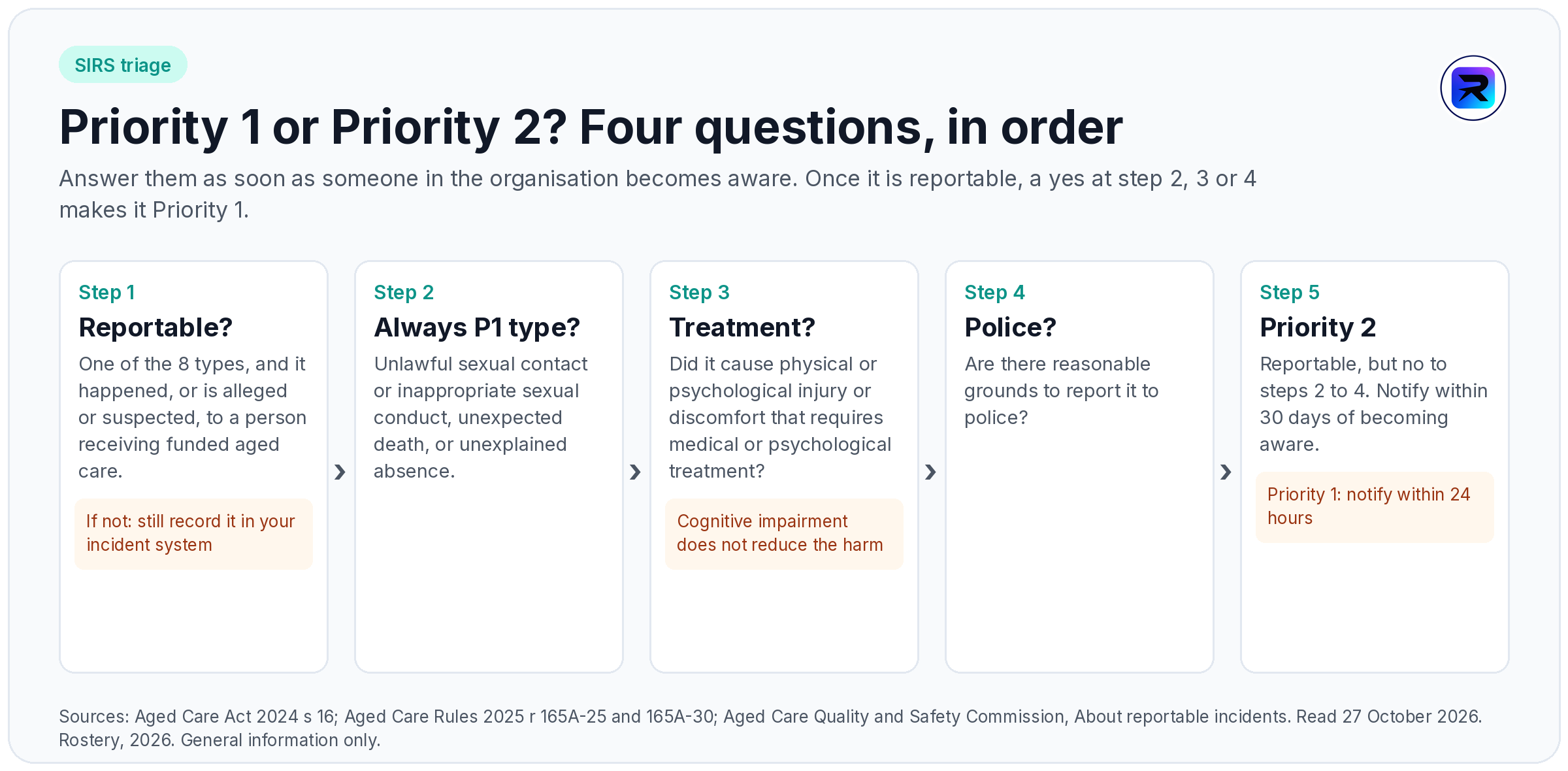
Question 3: does the person need medical or psychological treatment?
For the other five types, the next question is about harm. If the person was hurt or distressed badly enough to need treatment from a doctor, nurse, psychologist or similar health professional, it's Priority 1.
Be careful with clients who can't easily tell you how they feel. The Rules say a person's impairment can't be treated as reducing the harm. A client with dementia who seems settled may still be hurt or frightened.
Question 4: should the police know?
If there are reasonable grounds to report the incident to police, it's Priority 1, and the Commission says police should be told within 24 hours too. That applies even if the incident is only alleged or suspected. If you're not sure whether something is a crime, tell your coordinator, who can make that call with you. The Commission's advice when in doubt is to report it to police.
Question 5: if none of the above, what then?
If it's one of the eight types but the answers to questions 2 to 4 are all no, it's Priority 2. Your provider has 30 days to notify the Commission. That's not a reason to sit on it. Report it to your coordinator the same day, so they have the full picture while it's fresh.
And if it isn't one of the eight types at all, it still matters. Providers must record and manage every incident in their own incident management system, whether or not it goes to the Commission.
What to tell your coordinator
When you call or log it, try to cover:
- what happened, or what you were told, in your own words
- when it happened, if you know, and when you found out
- who was involved
- what you did straight away to keep the person safe, including calling an ambulance or a doctor
- anything you think the person might need now
The clock for your provider starts when anyone in the organisation becomes aware, and that includes you. A quick call tonight is worth more than a perfect write-up next week.
For coordinators and office staff
Write the time you were told, decide the priority with the questions above, and get the notice lodged in the My Aged Care provider portal within the deadline. If you're in Rostery, SIRS incident reporting records the incident with its SIRS type and priority, shows the deadline from the moment it's logged, and keeps the follow-up on the same record. You still lodge the notice yourself in the portal. For NDIS clients, a separate scheme run by the NDIS Commission applies, and Rostery's NDIS incident reporting handles those separately.
If your service also does NDIS work, our earlier Blogger post on five records that decide your NDIS audit is a good companion read.
General information only. We checked this against the Act, the Rules and the SIRS pages on the Commission's website on 27 October 2026.
The Rostery team
Comments
Post a Comment