
From the Rostery team in Sydney. We make software for NDIS and aged-care providers, and this is a short take for sole traders and small teams on a topic we covered in more depth on our own blog.
If you run a small NDIS business, you probably spend a fair bit of the week in the car. Some of that driving can be claimed from participants' plans and some can't, and the line between the two isn't always where people think. Here are five common mistakes with provider travel, and what to do instead.
General information only. Rules are from the NDIS Pricing Arrangements and Price Limits 2025-26 (v1.1), still the current claiming guidance on ndis.gov.au, read on 24 October 2026. Check the current version before you claim.
1. Charging travel the agreement doesn't mention
The participant has to agree to travel costs in advance, and the NDIA says the agreement should set out which travel costs can be claimed. If your service agreement is silent on travel, you can't bill it, however obvious the trip was.
The fix: add a travel clause to your agreement template. Cover whether you charge travel time and at what rate, the per-kilometre amount, how a trip is split if you see more than one participant on the same run, and whether the drive home is included.
2. Thinking any drive counts
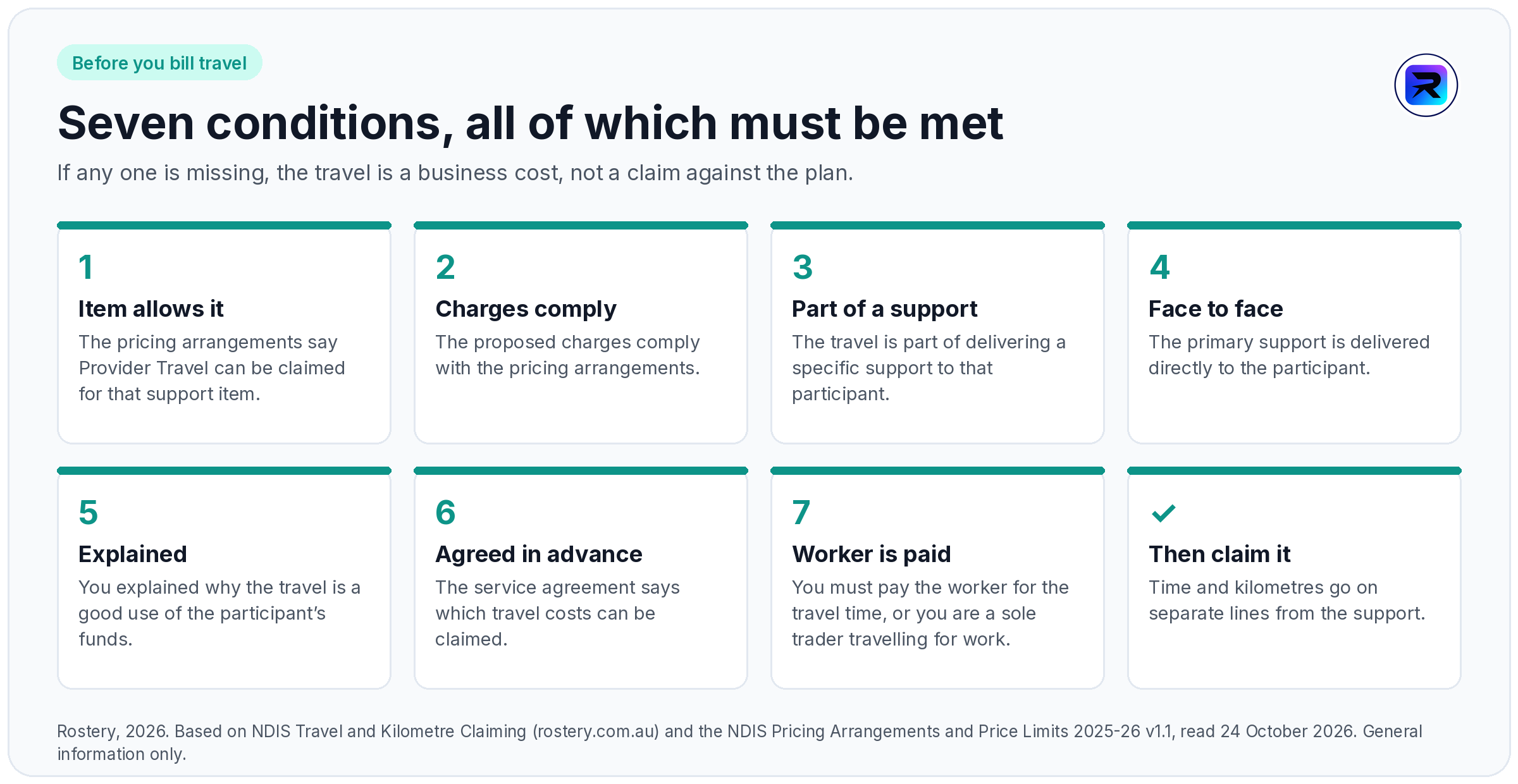
Travel can only be claimed when all of these are true: the support item allows Provider Travel, your charges comply with the pricing arrangements, the travel is part of delivering a support to that participant, the support is face to face, you've explained it, it was agreed in advance, and you have to pay the worker for the time. For a sole trader, that last one means you're travelling from your usual place of work to or from the participant, or between participants.
The fix: check each support item you deliver once, note whether travel is allowed, and keep that list handy.
3. Putting it all on one line
Travel is two claims, not one. The time spent driving goes on the same support item as the support, using the "Provider Travel" option, at the rate you agreed for the support or a lower one. The running cost of the car goes on a separate item, Provider travel – non-labour costs. And both are claimed separately from the support itself.
For a car owned by you or your worker, the NDIA considers up to $0.99 a kilometre a reasonable contribution. Tolls, parking and fares can go on at what they actually cost you.
The fix: think in threes. Every support with travel becomes three lines: the support, the travel time and the kilometres.
4. Getting the time limit wrong
Travel time is capped using the Modified Monash Model (MMM), based on where the participant is when the support is delivered:
- MMM 1 to 3: up to 30 minutes of travel to and from each participant.
- MMM 4 and 5: up to 60 minutes.
- MMM 6 and 7 (remote and very remote): no travel time limit. Specific arrangements with the participant apply, up to the hourly rate for the support.
The cap is a maximum, not a flat fee, so you claim the actual time up to the limit. For core and capacity building supports, the drive back from the last participant to your usual place of work can be claimed too, but only if you have to pay the worker for it, and within the same limit.
Therapy is the exception people trip on. Travel time for therapy is priced at half the regular price limit, and in the 2026-27 Pricing Schedule therapy items have their own Provider Travel items ending in _PT.
The fix: look up each participant's MMM area once, write it on their record, and let our free NDIS travel calculator apply the limits for you. If item numbers and price limits are still a bit of a mystery, start with our short explainer on how the NDIS price guide works.
5. Not writing the kilometres down
This one costs small providers the most. You finish a visit, drive 14 km to the next one and get on with it. Nobody asks you about that leg. The timesheet asks about hours, the progress note asks about the support, and by the time you sit down to do invoices a week later, the trip is gone.
Our original guide makes a simple point: you already know the addresses and the order you saw people in, so the trip can be worked out instead of remembered. Just don't let an unknown address turn into a zero, and treat a map distance as an estimate you can correct.
The fix: record travel at the end of each shift, not at invoice time. Then check it once: take one day last week with two visits and follow the travel through to the invoice. If it isn't there, you've found where the money went.
If you also reimburse workers by the kilometre, it helps to see how per-kilometre allowances can be applied from the shift, so the same distance drives both pay and billing.
One more thing: when the participant isn't there
If you arrive and the participant isn't home, that's a short notice cancellation question, not a travel one. Our free short notice cancellation calculator works through whether it can be charged.
For worked examples, the multi-participant split and how therapy travel is claimed in 2026-27, read our full guide, NDIS Travel and Kilometre Claiming: What Providers Can Actually Bill. And if you're newer to claiming in general, our earlier post on core supports in plain English is a good place to start.
Comments
Post a Comment